
There is dirt near the left window, not far from the carpet. Can you clean it up?
I gave my robot vacuum a brain.
It worked out which spot that was, drove over, cleaned it, and came back. No room numbers, no menus - just a description, the way you'd say it to a person.
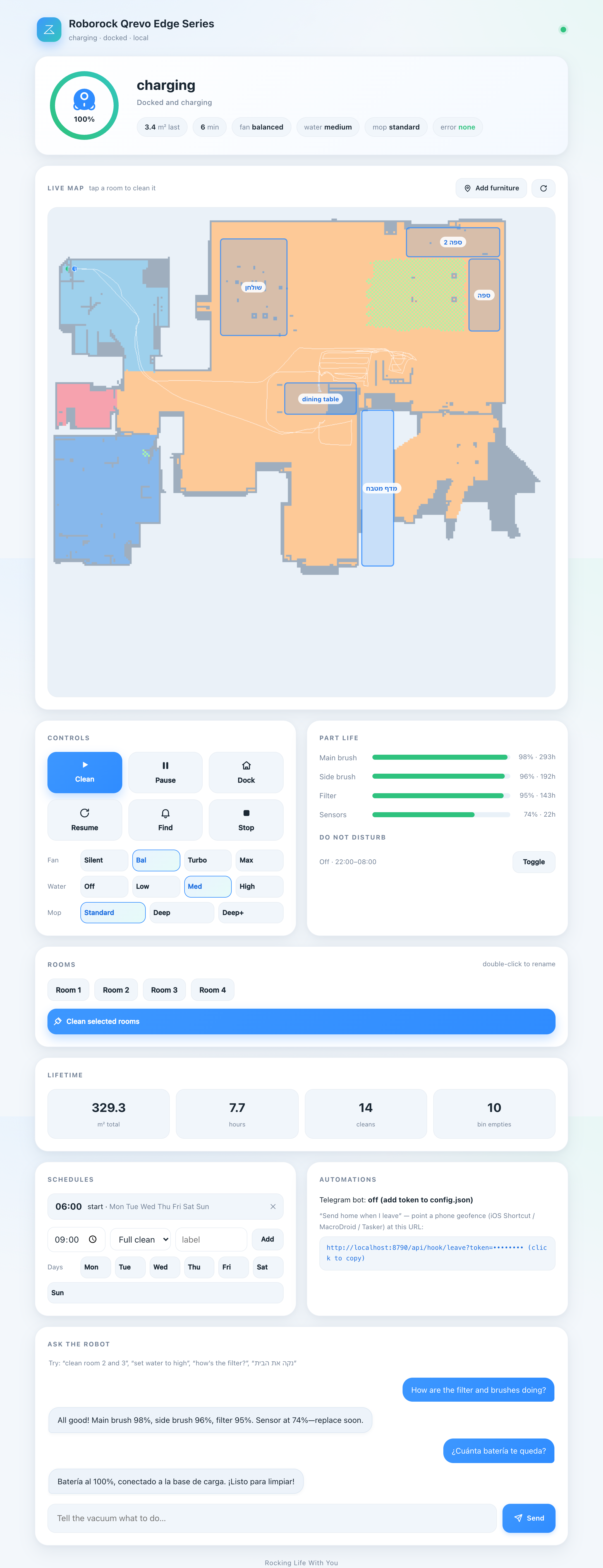
The moment it clicked
The vacuum already knew everything - a full map of my home, where every room is, even where the rugs are. It was all just locked behind an app. Hand that to a language model and you stop issuing commands: you describe a place the way you would to a person - in English, בעברית, Spanish, whatever you happen to think in - and it figures out the rest.
What it does
An app I actually own
Everything the official app does, plus the things I always wished it did - shaped exactly the way I live.
Talk to it in your language
It answers in whatever language you write in - tested in English, Hebrew, Spanish, French, German and Russian. "Clean rooms 2 and 3." "מה שלום הפילטר?" The AI turns intent into action.
It knows where things are
The map gives it the real layout - which room is where, and even where the rugs are. So "the spot by the carpet" is something it can actually find and clean.
I drew my own furniture on it
Drag a box around the sofa, name it, set the real size - a 200x90 cm table, a round plant. Then "to the right of the sofa" is measured from where the sofa actually ends.
Tap the map to clean a room
Your real floor plan, rooms colored. Touch a room and it cleans just that room - no menus.
Instant & sleep-proof
It connects over my home network, so it answers in a fraction of a second - and never "falls asleep" the way the cloud does.
Schedules & automations
Auto-clean at set times, "send it home when I leave," part-life tracking, and a Telegram bot - all optional, all mine.
The map
Rendered from the robot itself
The live floor plan is decoded straight from the vacuum and re-drawn to match the interface - soft rooms, walls, the cleaning path, and the robot's position. Then it becomes the control surface: tap to clean.

How it works
A language model as the interface
The pattern is simple, and it generalizes far beyond vacuums: connect to the device, and let an AI translate between human words and machine commands.
│ "clean the kitchen"
▼
Claude — turns intent into a structured action
▼
Controller ──► LOCAL connection on my Wi-Fi (fast, sleep-proof)
└─► CLOUD as a fallback + for the map
Engineering note: the "it keeps falling asleep" fix
The biggest annoyance with cloud control is that a docked robot goes to sleep and stops answering. The fix was to talk to it directly on the local network, where it stays reachable - it auto-discovers the vacuum's address and falls back to the cloud only when needed. Faster, and reliable.
The bigger picture
Personalization you build, not wait for
For years, a device meant its official app - one experience, the same for everyone. That's changing. When a device can share what it knows and an AI sits in the middle as a translator, you can shape your own interface, your own automations, your own assistant - in an afternoon. The wild part is how approachable it's become: a few hundred lines, an open-source library, and a modern AI model. This is just one vacuum. The same idea fits almost anything with a plug.

Everywhere
Works on the phone too
Same dashboard, responsive down to the phone - so it's there when I walk out the door and want to send it home.